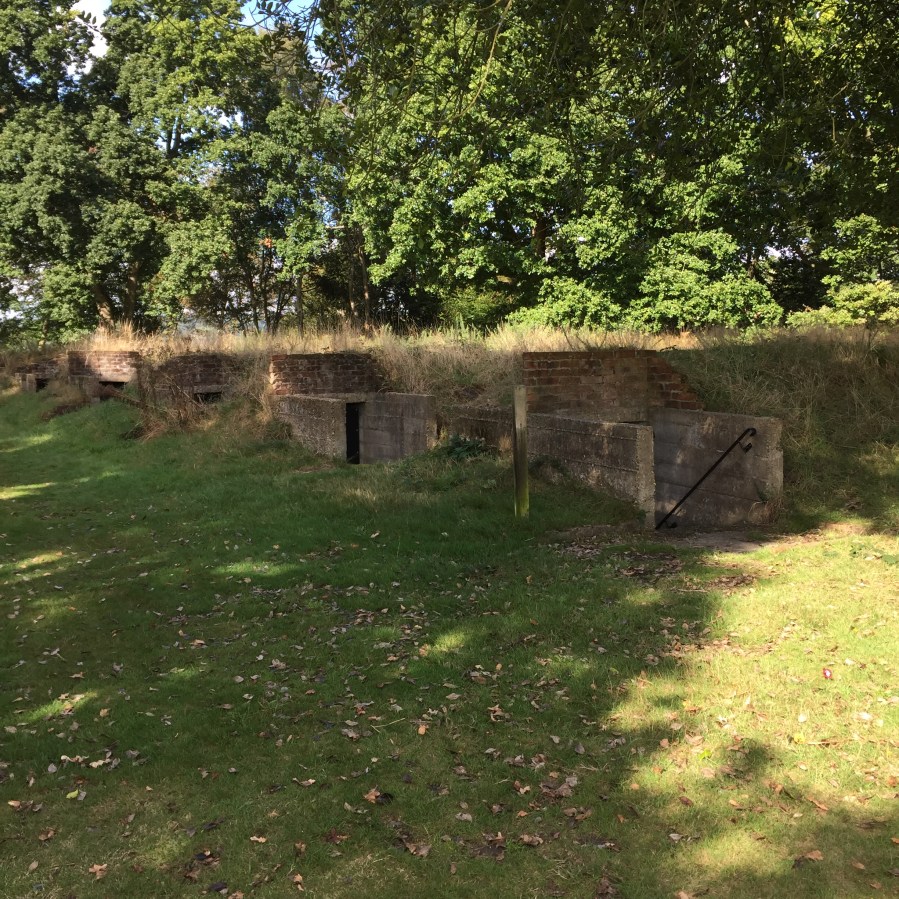
Limpsfield Common has a history spanning back centuries. In fact, stone has been quarried here as far back as the Domesday Book in the 11th century. The shallow stone pits can still be found while exploring the area today. However, the common is more famously known for its air raid shelters, which protected local school children from bombings during the Second World War.
Second World War at Limpsfield Common
During the Second World War, and particularly during the Battle of Britain in 1940, many ferocious dogfights occurred in the skies above east Surrey and Kent.
German bomber plans also often flew overhead on their way to target London. Although sometimes the aircrafts shed their bombs over Limpsfield Common as they fled the country pursued by British fighters.
Listen to our Podcast with Visit Surrey on BBC Sounds here – https://www.bbc.co.uk/sounds/play/p0l8rhpt
A full article on the BBC’s visit to the Air Raid Shelters is here: https://www.bbc.co.uk/news/articles/cz0d2xgry92o
Air raid shelters
Air raids were a very real threat to the people living in this area and in order to protect the students of Limpsfield School six air raid shelters were built on Limpsfield Common at the start of the war.
Building the shelters
To build the shelters a trench about 1.2 metres deep was dug filled with concrete to create the base. The roofs and walls were also made of concrete several inches thick.
These ‘trench style’ shelters could each hold around 50 children and were built about 500 metres from the school buildings.
Protecting local school children
The shelters were created in line with instructions from the Board of Education. According to the board, ‘in times of danger children should not be assembled in groups of [more than] 50’ and the buildings should have secure rooves giving them ‘immunity from splinters, anti-aircraft shell fragments and machine gun fire’.
What happened during an air raid
Once the air raid siren rang out – or the headmaster Mr Moulding range the school bell – the students and teachers would scramble to the shelters on Limpsfield Common.
From the school, the children had to cross the cricket ground and then a field laid with barbed wire fences. If they heard enemy aircraft overhead before they reached the shelters, they had to lie flat on the ground until the danger passed.
Sometimes children spent most of their school day inside the shelters, especially during the Battle of Britain.
Inside the air raid shelters
The children and teachers would have gone down a short set of steps and through a wooden door to enter the shelter. Once inside, students sat on wooden benches that ran down either side of the building.
From here teachers continued lessons – or at least, they’d try. It was often difficult to teach with the sound of aircraft battles roaring overhead. If the noise was too loud children would sometimes sing songs like Ten Green Bottles.
Teaching classes in the shelters
Reading and writing was also tough, because the shelter only had a few oil lamps along the walls. However, there’s evidence of cables and fixings so it’s believed that electricity was eventually added.
At the far end of the shelters there was a small curtained-off area, which hid a basic bucket-style toilet and a metal ladder. The ladder led to the escape hatch, which was meant to be used if the main entrance was ever damaged.
Air raids at night
The shelters weren’t only for children, and at night they became a haven for local families. Night raids were frequent as the German bombers flew overhead on their way to London.
Aircraft crash nearby
In one of the many dogfights over Limpsfield Common, a German fighter aircraft called a Messerschmitt 109 crashed close the air raid shelters on nearby New Road. As the aircraft burnt, the shelters were apparently filled with thick black smoke.
The air raid shelters today
In the years after the Second World War, the air raid shelters became overgrown and were in danger of being lost.
However, in 2006, one of the buildings was restored to its wartime condition so now people can visit the shelter and imagine how the school children felt as the sirens blasted and aircraft flew overhead.


Anti-tank weapon on Limpsfield Common
Near one of the air raid shelters on Limpsfield Common are the remains of a Spigot Mortar from the Second World War.
This anti-tank weapon was named after the steel pin or ‘spigot’ on which the gun was mounted, but it was also known as ‘Blacker Bombard’ after its inventor Lieutenant Colonel Blacker.
A wartime weapon
The Spigot Mortar was created at a time when the army needed cheap and easily produced weapons to replace the many that were lost at the Dunkirk evacuation in 1940.
However, the Spigot Mortar was extremely heavy. Weighing in at about 150 kilograms, it could fire a 9-kilogram high explosive anti-tank mortar bomb up to 91 metres effectively. Although it was most effective at shorter range.
Who used Spigot Mortars?
Spigot Mortars were issued to voluntary civilian soldiers, known as the Home Guard, in 1941 and used until 1944. Unfortunately, the weapon was almost as hazardous for the operator as it was the for the enemy.
Its stabilising fins had a tendency to fly back towards the person operating the gun.
How to use a Spigot Mortar
Believe it or not, the Spigot Mortar was originally designed to be mobile so was mounted on a large four-legged frame. However, this frame just made it even heavier and it took six men to move it. After a while, the legs were replaced by permanent mounting points.
These mounting points were essentially a column of concrete that stuck out from a small pit about 1.2 metres deep. On top of the base was a steel pin on which the gun was fitted.
The pit itself offered some protection to the Home Guard volunteers operating the gun and the ammunition was stored in small concrete recesses next to the pit.
The Spigot Mortar on Limpsfield Common
One of these permanent mounts can be found on Limpsfield Common today. The stainless-steel pin is in excellent condition and the crown and crowfoot stamp, which marks it as having been military equipment, is still clearly visible. The Spigot Mortar base was dug up and worked on by the Limpsfield Common Volunteer Taskforce.
Article from National Trust – History of Limpsfield Common – https://www.nationaltrust.org.uk/visit/surrey/limpsfield-common/history-of-limpsfield-common


Air Raid Shelter Experience Volunteers
We have a merry band of 12 volunteers who love dressing up and getting into WW2 character! They host regular Open Days and experiences at the Air Raid Shelters, attended by local schools, scouts, and general public. If you are interested in organising an experience for your local group or school, please get in touch.

Other articles & reviews
https://www.subbrit.org.uk/sites/limpsfield-school-air-raid-shelters/
 Friends of Limpsfield Common